

How Much Did It Cost To Clean Up The Pipeline Area After The.protester
The Native American protests confronting the Dakota Access pipeline have go an international rallying cry for ethnic rights and climate modify activism, drawing thousands to the rural area of Cannon Ball, North Dakota.
As the controversial oil pipeline approaches the river that the Standing Rock Sioux tribe fears information technology will contaminate – and equally a militarized police force continues to engage in tense standoffs with demonstrators – here is what we know and so far.
What is the Dakota Access pipeline?
The Dakota Access pipeline (DAPL) is a $3.7bn project that would transport crude oil from the Bakken oil field in North Dakota to a refinery to Patoka, Illinois, near Chicago.
The 1,172-mile pipeline, roughly xxx inches in bore, would carry 470,000 barrels per solar day and is a project of company Energy Transfer Partners.
Who is opposing the project and why?
The local Standing Rock Sioux tribe and thousands of Native American supporters from across Northward America accept fix camps in Cannon Ball to try and block the oil project. Opponents of DAPL say the project threatens sacred native lands and could contaminate their h2o supply from the Missouri river, which is the longest river in North America.
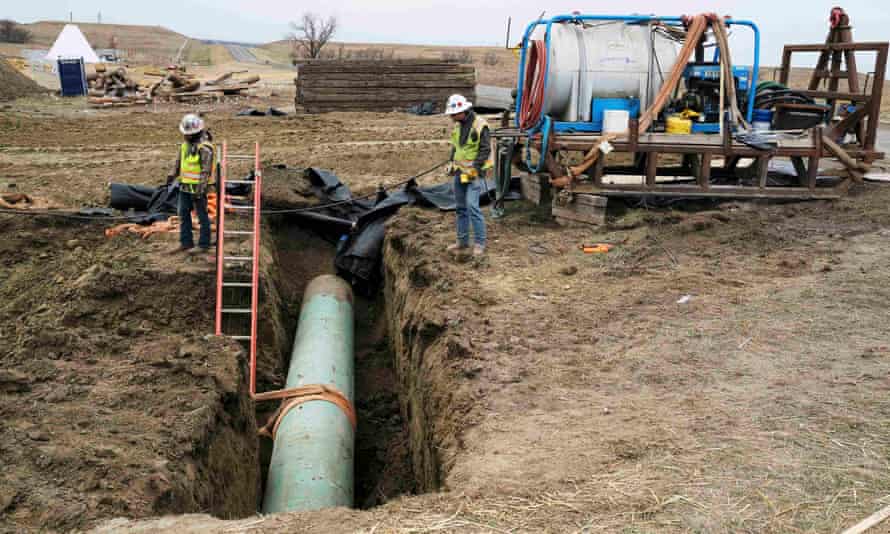
Activists call themselves "water protectors" and argue that the pipeline poses like threats to the now defeated Keystone XL, merely lament that DAPL has failed to garner the aforementioned amount of national attention. Tribal leaders also say that the The states ground forces corps of engineers' initial determination to permit the pipeline to run within a one-half-mile of the local reservation was done without consulting tribal governments and without a thorough report of impacts.
This means, the tribe says, that the projection violates federal law and native treaties with the US government.
Where are the protests taking place?
The offset protest military camp emerged in April when members of the Standing Rock Lakota and other Native American nations rode on horseback and established a spiritual camp called Sacred Stone.
Several other big camps, featuring a diverse mix of tribes and non-native supporters, have since emerged nearby. The main army camp where more than 1,000 are gathered is called Oceti Sakowin. The Standing Rock camps are all located about an hour south of Bismarck, North Dakota, though law have established strict roadblocks along 1806, the main local highway, meaning visitors have to head west and enter from the due south to get to the demonstration.
Some of the camps are on lands controlled by the US army corps of engineers and other sites are on private land owned by Ladonna Allard, a fellow member of the Dakota Sioux.
How far forth is the project?
In North Dakota, the pipeline construction has chop-chop avant-garde toward the protest camps and the Missouri river. Equally of the commencement of Nov, tribal leaders said information technology appeared equally if the construction project was nearing completion – within a few miles of the water, maybe less. The tribe said the digging has already disrupted sacred burying grounds and that if the project goes under the river and gets whatsoever closer to the reservation, there could exist irreversible damage to their land and cultural heritage.
Energy Transfer Partners recently said it is on track to have the entire pipeline "ready for service" past the stop of 2022.
What tactics accept protesters used to fight structure?
The protestation camps have repeatedly emphasized that they intend to remain unarmed and peaceful. As the pipeline has gotten closer to the Missouri river, activists have attempted to set up upward camps and prayer circles on the property where construction is planned.
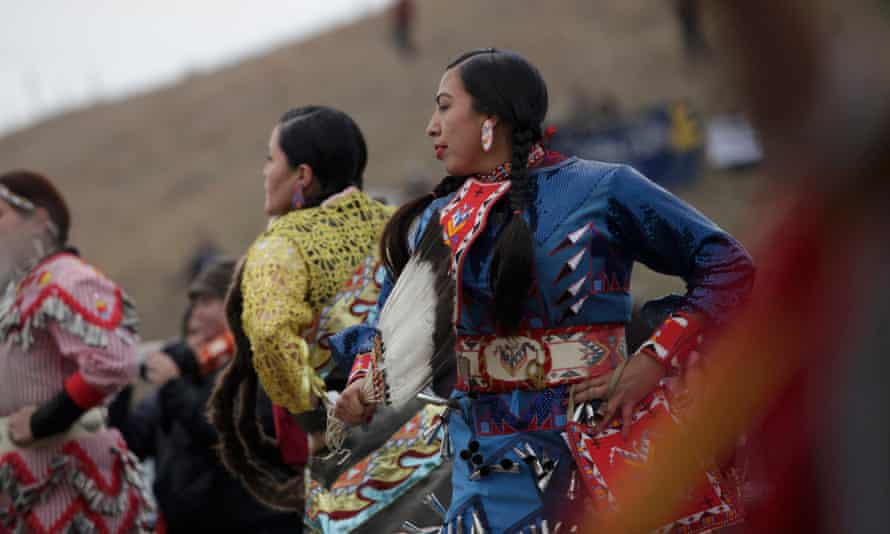
Youth leaders have ofttimes been on the frontlines of standoffs with constabulary, at times facing Mace, rubber bullets and other threats from constabulary enforcement. Elderly leaders have too led demonstrations.
How has the federal government responded?
The US regular army corps of engineers, along with a number of federal agencies, appear in September that it was reviewing its approvals and temporarily halting permits for construction on federal state most or under the Missouri river.
In his offset remarks since protests escalated, Barack Obama said the regular army corps was studying whether the pipeline could be rerouted effectually sacred native lands. His comments, published on 1 November, did not include specific proposals or commitments and said the government was "going to let it play out for several more weeks and make up one's mind whether or not this can be resolved in a way that I think is properly circumspect to the traditions of the first Americans".
How take police responded to demonstrations?
The Morton County sheriff's function, along with Cass Canton law enforcement and supporting police agencies from across the state, take formed a highly militarized constabulary force that has aggressively targeted protesters attempting to block construction.
Equally of November, police have made more than 400 arrests, many of which occurred during two separate protest clashes inside one week.
Police force, who are frequently armed with large tanks and anarchism gear, have used pepper spray, teargas, prophylactic bullets, Tasers and other "less-than-lethal" tools to respond. Jack Dalrymple, North Dakota's governor, as well called in the national baby-sit.
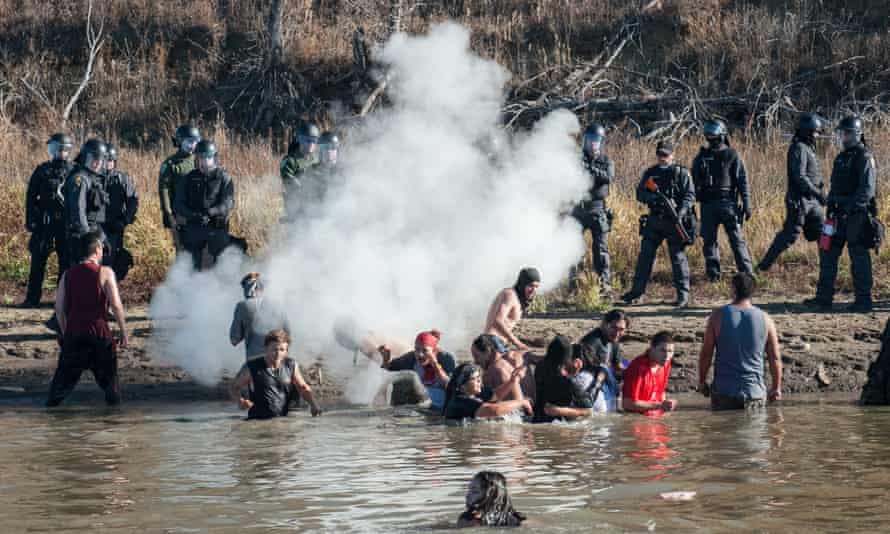
Law enforcement leaders accept charged Native Americans, journalists and film-makers, with rioting, criminal trespass, resisting arrest and a range of more serious felonies. Police have also been accused of human rights violations in their treatment of jailed protesters, and a United Nations group opened an investigation into local police enforcement.
Police force officials merits that they have been forced to arrest protesters when they enter the holding where construction is planned. Local officials accept likewise slammed Obama, saying he has not washed plenty to help law enforcement and stop protesters.
What is the status of the tribe's court fight against the project?
The Standing Rock tribe is also fighting the project in court, arguing that the approvals of the project were improper and that the authorities has failed to do a written report that would assess the big-scale affect of the pipeline.
But in September, federal gauge James Boasberg ruled that the US regular army corps of engineers "likely complied" with the National Historic Preservation Human activity.
The tribe has also argued that the pipeline violates the United Nations' annunciation on the rights of indigenous peoples.
What has Energy Transfer Partners said about the protests?
Free energy Transfer Partners said in court filings in September that the Dakota Access pipeline is 45% complete and that a temporary injunction to stop it would accept "devastating short and long-term impacts". The company has also previously denounced "threats and attacks" perpetrated upon its employees.
In response to concerns of contagion and environmental hazards, DAPL has argued that pipelines are the safest, nearly efficient method of transporting oil. The visitor also claims that increased product in the Bakken oil field has led to a ascension in the shipment of oil by rail and truck, leaving less transportation bachelor for regional agriculture.
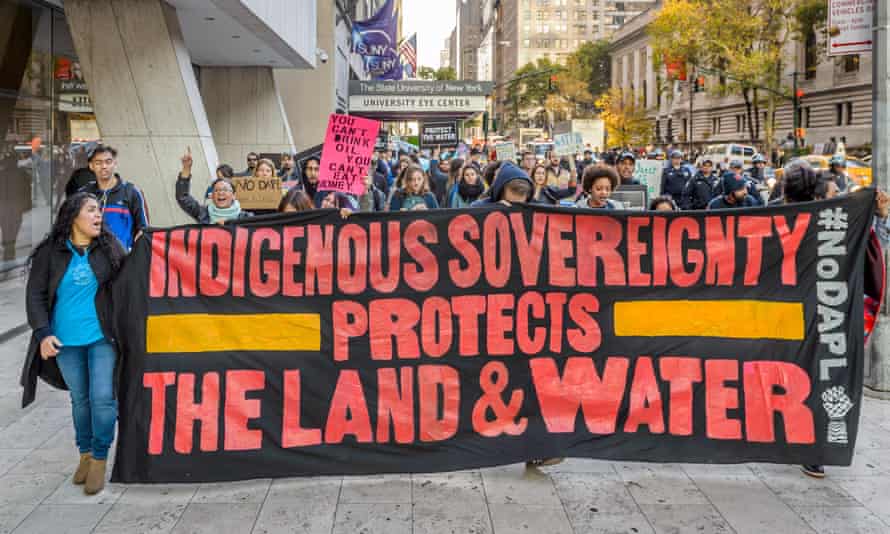
What have Hillary Clinton and Donald Trump said well-nigh DAPL?
Subsequently a grouping of Standing Rock youth staged a protest at the Brooklyn campaign headquarters of Hillary Clinton in late October, the Democratic presidential nominee released a short argument that did not take a stance on the pipeline or the protests.
She said she believed "all voices should be heard", adding: "It'due south important that on the ground in Due north Dakota, everyone respects demonstrators' rights to protest peacefully, and workers' rights to do their jobs safely."
Republican nominee Donald Trump has non publicly commented on the protests, but it was revealed in October that he has close fiscal ties to Energy Transfer Partners.
Who else is supporting the protesters?
The anti-pipeline movement has attracted support on the ground from actor Shailene Woodley, who was arrested while protesting, and Mark Ruffalo, who visited in October. Civil rights leader Jesse Jackson also made an appearance at the site.
Us senator Bernie Sanders, who lost to Clinton in the Democratic master, has too issued numerous statements in support of the protest.
Dark-green political party candidate Jill Stein faced charges for graffiti at the pipeline protest.
- No billionaire possessor, no shareholders. Just independent, investigative reporting that fights for the truth, any the cost. Why not support it? Go a Guardian Usa member for $49 a yr, or make a contribution.

Source: https://www.theguardian.com/us-news/2016/nov/03/north-dakota-access-oil-pipeline-protests-explainer
Posted by: stevenshicupok.blogspot.com
0 Response to "How Much Did It Cost To Clean Up The Pipeline Area After The.protester"
Post a Comment