

How To Clean Smart Board Surface

Smart Surfaces Coalition
The Smart Surfaces Coalition is committed to the rapid, cost-effective global adoption of smart surfaces to enable cities to thrive despite climate threats, save cities billions of dollars, decrease heat, reduce flood risk, slow global warming, and improve city livability, health, equity, and jobs.
Who We Are
We help cities make "smart" surface decisions by demonstrating the value of surfaces that manage the sun and rain. By using Smart Surfaces where appropriate, cities around the world can reduce extreme summer heat by several degrees, stem flooding, improve public health, create jobs, and advance equity—all while saving money.
Interested in learning more about our work?
SMART SURFACE Solutions
Cities that deploy Smart Surfaces reduce temperatures, save money, and make communities more livable.

Cool Roofs
Cool roofs are light colored and engineered to reflect away most heat—unlike traditional dark colored roofs. When summer sunlight hits a dark roof, 52% heats the city air, compared to 8% for light colored roofs which reflect a lot of sunlight and heat back into space.

Green Roofs
Green roofs are covered in vegetation, which provides shading, reduces building energy use, cleans the air, and absorbs and better manages water.

Trees
Trees decrease temperature by providing shade and transpiring. Trees turn CO2 into oxygen, clean air pollutants, and reduce flood risk by absorbing water during heavy rains.

Solar
Solar PV converts sunshine into electricity and provides shading for buildings, sidewalks, and other public areas.

Reflective Pavements
Reflective (or 'high albedo') pavements include light-colored roads, sidewalks, and parking lots. These pavements use a reflective sealant to bounce sunlight and heat away from the city instead of being absorbed by the dark pavement and reradiated as heat into the city air. They also protect the pavement, extending its useful life.
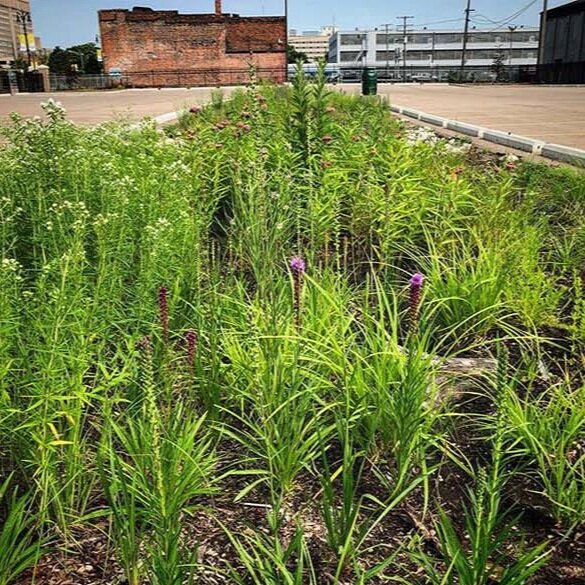
Bioretention
Bioswales, raingardens, and other forms of bioretention reduce stormwater runoff, risk of flooding and stormwater system overflow by allowing rain to run off into green, porous basins, recharging groundwater.

Porous Pavements
Porous pavements reduce stormwater runoff by allowing rain to pass through the surface, recharging groundwater while reducing flood risk.

Carbon-Sequestering Concrete
Concrete can now be carbon-neutral or even carbon-negative. Carbon-sequestering concrete also has a relatively high albedo.

Combined Surfaces
By combining Smart Surface solutions, cities can maximize the benefits from a single area. For example:
Green roofs + Solar PV generate clean energy, reduce building energy use, manage storm water, and clean the air;
Porous + cool surfaces reflect heat, capture rain, and clean the air.
The Smart surfaces blog
Featured

A Q+A with Jennifer Roberts, a member of SSC's Steering Committee and a former Mayor of Charlotte and Director of The Path to Positive Communities Program with EcoDistricts.

A Q+A with Ian Riley, a member of SSC's Steering Committee. Ian is the CEO of the World Cement Assocation.

A Q+A with Pastor William Lamar, a member of SSC's Steering Committee and Pastor of Metropolitan African Methodist Episcopal Church.

A Q+A with Julie Katzman, a member of SSC's Steering Committee. Julie was a former COO of the Inter-American Development Bank and currently serves on the board of the MacArthur Foundation, Instituto de Empresa, Laboratoria.la, and Nilus.
Research and Reports
Featured
In this report, the costs and benefits of adopting Smart Surfaces in Stockton, CA, a representative hot-dry climate city, are modeled.
In this report, we have expanded the technical depth of analysis from these prior reports. We analyze and model in detail the economic costs and benefits, as well as temperature reduction impact, of one city—Baltimore—adopting Smart Surfaces.
This report analyzes the potential of Smart Surfaces to be financed by the Clean Energy and Sustainability Accelerator
This report analyzes the effect of climate change related risks on city credit rating and how smart surface implementation can mitigate this risk for cities.
Watch: The Smart Surface Transformation Story

How To Clean Smart Board Surface
Source: https://smartsurfacescoalition.org/
Posted by: stevenshicupok.blogspot.com
0 Response to "How To Clean Smart Board Surface"
Post a Comment